|
|
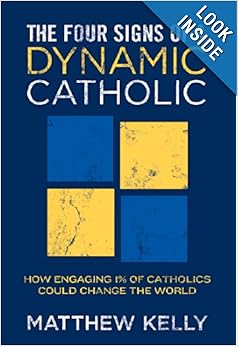
The Four Signs of a Dynamic Catholic, How Engaging One Percent of Catholics Could Change the World, by Matthew Kelly. Dynamic Catholic.com,
2012.
Kelly believes that five holy persons, namely Mother Teresa, Francis of Assisi, John Paul II, Therese of Lisieux, and Ignatius of Loyola had four things in common. Would you like to wager a guess as to what these four things
are?
The author calls these four things: prayer, study, generosity, and evangelization. He finds these elements in the life of each of the forenamed persons. The purpose of this book is to take note of the
fact that only about seven percent of Catholics are responsible for the viability of any one parish. He deplores this fact and emphasizes this sadly as he encourages the other ninety-three percent to "get with the program". Kelly approaches this dilemma in a creative way, inviting Catholics to pray just a few minutes longer each day, to study a bit more every day, to give a little more generously than last year, and to reach out to just one person and invite them to join in the
body of Christ, the Church.
To achieve these goals, Kelly starts out with providing free copies of this book to a number of parishes scattered throughout the United States. If he can get just one person in each parish to practice the four signs of living faith, he has counted the increase in the number of "new Catholics". He wants each of these "New" persons to say, " One minute
more of prayer a day? Yes, I can do that". "A bit more study? "That I can do", and so on.
In Kelly's study as he was preparing to write to this book, he carried out a survey to determine how many are contributing Catholics, how many are really dynamic Catholics, how many support financially the church, how many are inviting new members. The responses saddened his heart when he found
that only seven percent are doing almost everything in their faith community and paying almost entirely for the maintenance and mission of the church. (Although his survey was with the Catholic Church, he believes it can easily be applied to churches of various denominations).
Kelly writes: "The future of the Catholic Church depends upon us finding out what makes this small group of
Catholics so engaged. If we cannot identify what drives their engagement, we cannot replicate it."
Back to the four signs, Kelly takes his readers step by step in a direction that will help people develop a more vibrant faith, much like the five holy ones he introduces earlier. This is an intriguing journey and faithfulness to the four steps will hopefully reap great rewards in
personal lives and in the individual congregations of Christians.
Interesting reading! Promises of hope! Great chapter- ending summaries! Easy reading! Give Matthew Kelly a try! You won't regret it!
Paperback and Kindle
|
Saint of the Week
|
St. Thomas Aquinas (1225-74): January 28
By universal consent, Thomas Aquinas is the preeminent spokesman of the Catholic tradition of reason and of divine revelation. He is one of the great teachers of the medieval Catholic Church, honored with the titles Doctor of the Church and Angelic Doctor.
At five he was given to the Benedictine monastery at Monte Cassino in his parents' hopes that he would choose that way of life and eventually became abbot. In 1239 he was sent to Naples to complete his studies. It was here that he was first attracted to Aristotle's philosophy.
By 1243, Thomas abandoned his family's plans for him and joined the Dominicans, much to his mother's
dismay. On her order, Thomas was captured by his brother and kept at home for over a year.
Once free, he went to Paris and then to Cologne, where he finished his studies with Albert the Great. He held two professorships at Paris, lived at the court of Pope Urban IV, directed the Dominican schools at Rome and Viterbo, combated adversaries of the mendicants, as well as the Averroists, and argued with some
Franciscans about Aristotelianism.
His greatest contribution to the Catholic Church is his writings. The unity, harmony and continuity of faith and reason, of revealed and natural human knowledge, pervades his writings. One might expect Thomas, as a man of the gospel, to be an ardent defender of revealed truth. But he was broad enough, deep enough, to see the whole natural order as coming from God the Creator, and
to see reason as a divine gift to be highly cherished.
The Summa Theologiae, his last and, unfortunately, uncompleted work, deals with the whole of Catholic theology. He stopped work on it after celebrating Mass on December 6, 1273. When asked why he stopped writing, he replied, "I cannot go on.... All that I have written seems to me like so much straw compared to what I have seen and what has been revealed to
me." He died March 7, 1274. americancatholic.org site
|
|
Affliate Web Sites: Please give them a visit. |
|
|
|
|
|
|