
Book of the Week
|
The Breath of the Soul: Reflections on Prayer, by Joan Chittister, OSB. Twenty-third Publications, 2009.
This simple little book from a great spiritual giant attends to what we human beings are most inclined to forget, preparing for and engaging in prayer. It is an examination of what we ourselves must bring to the discipline of prayer whatever form it takes in order to make prayer authentic and real, a deep and profound part of our lives.
Prayer is the link to a life beyond the mundane, the daily, the routine, the immediate dimensions of life. It is the beginning of a relationship with the God who is closer to us than we are to ourselves. It is a relationship with both creation and the Creator. It helps us grow into the fullness of ourselves, both spiritually and psychologically.
But authentic prayer requires something from us, as well as from the God we seek. It requires that we bring to it an open heart, a good deal of self-knowledge, constancy in darkness, and a willingness to attend to the Light, even when all we can see is darkness.
None of the brief reflections in this book are ever finished, ever closed, ever fully resolved. They are all ongoing steps along the way, steps we retrace over and over again as we do all the other parts of life, until they become the very breath we breathe, the vision and energy of our souls.
This is great spiritual reading for every person who longs for prayer to be the the very breath of his or her soul.
- Amazon.com book descriptor
Link to hardback; Kindle edition available
|
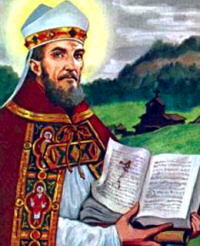
Saint of the Week
|
St. Boniface (672-754): May 27
Boniface, known as the apostle of the Germans, was an English Benedictine monk who gave up being elected abbot to devote his life to the conversion of the Germanic tribes. Two characteristics stand out: his Christian orthodoxy and his fidelity to the pope of Rome.
How absolutely necessary this orthodoxy and fidelity were is borne out by the conditions he found on his first missionary journey in 719 at the request of Pope Gregory II. Paganism was a way of life. What Christianity he did find had either lapsed into paganism or was mixed with error. The clergy were mainly responsible for these latter conditions since they were in many instances uneducated, lax and questionably obedient to their bishops. In particular instances their very ordination was questionable.
These are the conditions that Boniface was to report in 722 on his first return visit to Rome. The Holy Father instructed him to reform the German Church. The pope sent letters of recommendation to religious and civil leaders. Boniface later admitted that his work would have been unsuccessful, from a human viewpoint, without a letter of safe-conduct from Charles Martel, the powerful Frankish ruler, grandfather of Charlemagne. Boniface was finally made a regional bishop and authorized to organize the whole German Church. He was eminently successful.
In the Frankish kingdom, he met great problems because of lay interference in bishops' elections, the worldliness of the clergy and lack of papal control.
During a final mission to the Frisians, he and 53 companions were massacred while he was preparing converts for Confirmation.
americancatholic.org site
|
|
Affliate Web Sites: Please give them a visit. |
|
|
|
|
|
|

