|

Book of the Week
|
Cravings: A Catholic Wrestles with Food, Self-Image, and God, by Mary DeTurris Poust. Ave Maria Press, 2012.
This is not a book on dieting, but it may urge one to begin a "holy" diet, fasting not to improve one's waist line but to become more aware of God's gifts of foods that are available. Poust shares the wisdom she has gained on the complex relationship between food and spirituality. She shares her appreciation of meals learned from her Italian-American family. She makes clear the connections between eating, self-image, and the spiritual life. Poust warns of the danger of using food to avoid or suggest real desires, such as acceptance, understanding, friendship, and even love for another.
The eight chapters of this book tell the story quite well: Filling the spiritual void with food; dieting as a delusion; discovering our true selves; breaking the chain of high-fat, fast-food culture; how and why we eat; cues from the monastics; turning meals into meditation; and you can have your cake and spiritual life too.
In the appendix, Poust offers a ten step plan for saner, mindful eating: turning to food when not really hungry; prepare meals with thought; do not eat on the run; bless your food; look at your food...is it right for you; smell your food; eat slowly; concentrate on the taste and texture of the food; keep a record of what you eat; make the clean-up time a prayerful action.
"Food and our relationship with it has gotten a bad rap right from the beginning (Remember the apple in Eden). What chance did it have when the whole of humanity's downfall hung on one bite of the wrong food. .....The connection between food and faith certainly doesn't end there. The apple in the Garden of Eden was really just a crudite' in the endless banquet that is our spiritual story." Fasting and feasting culminate in the ultimate feast, the Eucharist. "Ours is a faith centered on a meal." Can we make each meal a faith-centered event? (Thanks to Sr. Irene Hartman OP for this review.)
Link to paperback; Kindle edition available
|
Saint of the Week
|
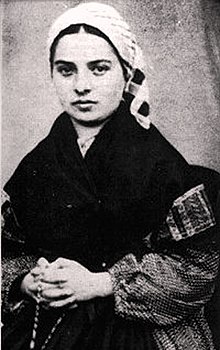
St. Bernadette Soubirous (1844-79): April 16
Bernadette Soubirous was born in 1844, the first child of an extremely poor miller in the town of Lourdes in southern France. The family was living in the basement of a dilapidated building when on February 11,1858, the Blessed Virgin Mary appeared to Bernadette in a cave above the banks of the Gave River near Lourdes. Bernadette, 14 years old, was known as a virtuous girl though a dull student who had not even made her first Holy Communion. In poor health, she had suffered from asthma from an early age.
There were 18 appearances in all, the final one occurring on the feast of Our Lady of Mt. Carmel, July 16. Although Bernadette's initial reports provoked skepticism, her daily visions of "the Lady" brought great crowds of the curious. The Lady, Bernadette explained, had instructed her to have a chapel built on the spot of the visions. There the people were to come to wash in and drink of the water of the spring that had welled up from the very spot where Bernadette had been instructed to dig.
According to Bernadette, the Lady of her visions was a girl of 16 or 17 who wore a white robe with a blue sash. Yellow roses covered her feet, a large rosary was on her right arm. In the vision on March 25 she told Bernadette, "I am the Immaculate Conception." It was only when the words were explained to her that Bernadette came to realize who the Lady was.
Few visions have ever undergone the scrutiny that these appearances of the Immaculate Virgin were subject to. Lourdes became one of the most popular Marian shrines in the world, attracting millions of visitors. Miracles were reported at the shrine and in the waters of the spring. After thorough investigation Church authorities confirmed the authenticity of the apparitions in 1862.
During her life Bernadette suffered much. She was hounded by the public as well as by civic officials until at last she was protected in a convent of nuns. Five years later she petitioned to enter the Sisters of Notre Dame. After a period of illness she was able to make the journey from Lourdes and enter the novitiate. But within four months of her arrival she was given the last rites of the Church and allowed to profess her vows. She recovered enough to become infirmarian and then sacristan, but chronic health problems persisted. She died on April 16, 1879, at the age of 35.
She was canonized in 1933.
americancatholic.org site
|
|
|
|
|
|

