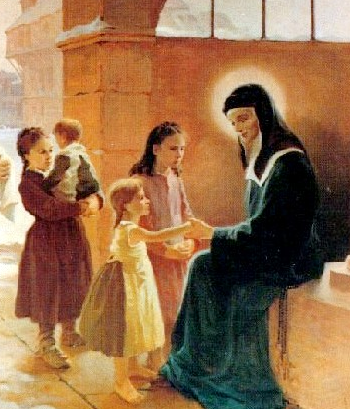
St. Louise de Marillac (d. 1660): March 15
Louise, born near Meux, France, lost her mother when she was still a child, her beloved father when she was but 15. Her desire to become a nun was discouraged by her confessor, and a marriage was arranged. One son was born of this union. But she soon found herself nursing her beloved husband through a long illness that finally led to his death.
Louise was fortunate to have a wise and sympathetic counselor, St. Francis de Sales, and then his friend, the Bishop of Belley, France. Both of these men were available to her only periodically. But from an interior illumination she understood that she was to undertake a great work under the guidance of another person she had not yet met. This was the holy priest M. Vincent, later to be known as St. Vincent de Paul.
At first he was reluctant to be her confessor, busy as he was with his "Confraternities of Charity." Members were aristocratic ladies of charity who were helping him nurse the poor and look after neglected children, a real need of the day. But the ladies were busy with many of their own concerns and duties. His work needed many more helpers, especially ones who were peasants themselves and therefore close to the poor and could win their hearts. He also needed someone who could teach them and organize them.
Only over a long period of time, as Vincent de Paul became more acquainted with Louise, did he come to realize that she was the answer to his prayers. She was intelligent, self-effacing and had physical strength and endurance that belied her continuing feeble health. The missions he sent her on eventually led to four simple young women joining her. Her rented home in Paris became the training center for those accepted for the service of the sick and poor. Growth was rapid and soon there was need of a so-called rule of life, which Louise herself, under the guidance of Vincent, drew up for the Sisters of Charity of St. Vincent de Paul (though he preferred "Daughters" of Charity).
He had always been slow and prudent in his dealings with Louise and the new group. He said that he had never had any idea of starting a new community, that it was God who did everything. "Your convent," he said, "will be the house of the sick; your cell, a hired room; your chapel, the parish church; your cloister, the streets of the city or the wards of the hospital." Their dress was to be that of the peasant women. It was not until years later that Vincent de Paul would finally permit four of the women to take annual vows of poverty, chastity and obedience. It was still more years before the company would be formally approved by Rome and placed under the direction of Vincent's own congregation of priests.
Many of the young women were illiterate and it was with reluctance that the new community undertook the care of neglected children. Louise was busy helping wherever needed despite her poor health. She traveled throughout France, establishing her community members in hospitals, orphanages and other institutions. At her death on March 15, 1660, the congregation had more than 40 houses in France. Six months later St. Vincent de Paul followed her in death.
Louise de Marillac was canonized in 1934 and declared patroness of social workers in 1960.