|
Book of the Week
|
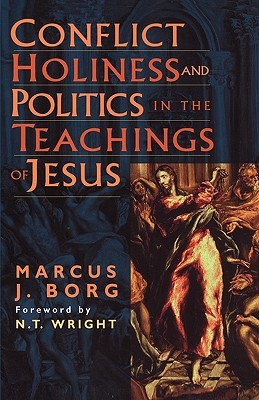
Conflict, Holiness and Politics in the Teachings of Jesus, by Marcus J. Borg. Trinity Press International.1998
Just after following the campaign and election of Barak Obama for about a year...isn't that a good time to read about Jesus and His part in the politics of His day? The author offers some ideas about Jesus' teaching in relation to the political conflicts of Judaism of His day. This book gives an argument that is crisp and clear. "It carves out fresh space which many readers of the New Testament had never imagined existed, and then proceeds to fill that space with historical reconstruction and exegetical detail that is not only patient and well-documented but also creative and innovative."
The main themes of this book center on Jewish resistance to Rome, quest for holiness, opposition, alternative paradigm, the Sabbath, the Temple, Jesus and the Future, and Prophetic Conflict and Mystical Eschatology. Borg makes it clear that politics and piety were not kept in separate compartments in the time of Jesus. Loyalty to the Temple and loyalty to the Torah were the twin symbols around which resistance to pagan rule organized itself, and demanded holiness. The Temple was the center of the great system of holiness, and the Torah kept everyone in line according to specific patterns. Social justice within Jewish society was the order of the day for Jesus and it was in this area especially that He found dissenters.
Not all Jews were of the same mind as Jesus, and He ran into difficulties when He seemed to be breaking the law in order to do the works of mercy. Jesus ran into serious misunderstandings when He, for example, performed miracles on the Sabbath. For the Jewish Jesus, mercy meant holiness. Few could comprehend that concept. And they crucified Him! (Thanks to Sr. Irene Hartman OP for this review.)
Amazon.com link
|
|
Saint of the Week
|
St. Anthony of Egypt (251-356): January 17 The life of Anthony will remind many people of St. Francis of Assisi. At 20, Anthony was so moved by the Gospel message, "Go, sell what you have, and give to [the] poor" (Mark 10:21b), that he actually did just that with his large inheritance. He is different from Francis in that most of Anthony's life was spent in solitude. He saw the world completely covered with snares, and gave the Church and the world the witness of solitary asceticism, great personal mortification and prayer. But no saint is antisocial, and Anthony drew many people to himself for spiritual healing and guidance.
At 54, he responded to many requests and founded a sort of monastery of scattered cells. Again like Francis, he had great fear of "stately buildings and well-laden tables."
At 60, he hoped to be a martyr in the renewed Roman persecution of 311, fearlessly exposing himself to danger while giving moral and material support to those in prison. At 88, he was fighting the Arian heresy, that massive trauma from which it took the Church centuries to recover. "The mule kicking over the altar" denied the divinity of Christ.
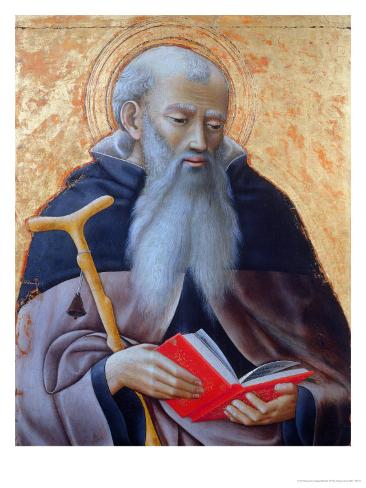
Anthony is associated in art with a T-shaped cross, a pig and a book. The pig and the cross are symbols of his valiant warfare with the devil--the cross his constant means of power over evil spirits, the pig a symbol of the devil himself. The book recalls his preference for "the book of nature" over the printed word. Anthony died in solitude at 105.
americancatholic.org site
|
|
|
|
