Weekend Edition - A Daily Spiritual Seed
Published: Fri, 10/19/12
A Daily Spiritual Seed
Weekend Edition:
October 19-21, 2012
| Contents: - Weekend Scripture Readings - Spiritual Guidance - Discussion Board highlights - Affiliate Web Sites - Theology Note of the Week - Spiritual Growth Resources. - Book of the Week - Saint of the Week - Joke of the Week - Web Resource of the Week - - - Sunday: Is 53:10-11; Ps 33:4-5, 18-20, 22; Heb 4:14-16; Mk 10:35-45 R. (22) Lord, let your mercy be on us, as we place our trust in you.  Upright is the word of the LORD, Upright is the word of the LORD,and all his works are trustworthy. He loves justice and right; of the kindness of the LORD the earth is full. See, the eyes of the LORD are upon those who fear him, upon those who hope for his kindness, To deliver them from death and preserve them in spite of famine. Our soul waits for the LORD, who is our help and our shield. May your kindness, O LORD, be upon us who have put our hope in you. - - - Amazon
Gift Cards - - - Spiritual Guidance - see http://shalomplace.org/eve/forums
for these and hundreds of other
discussions. The Sanctuary
Foundation for Prayer: resources for spiritual growth. Theology Note of the
Week A paradigm is a set of assumptions and or presuppositions that prescribe a way of looking at things. It is a framework of beliefs and/or assumptions through which we understand the world, ourselves, and others. Everyone has a paradigm, a worldview, through which and by which they interpret the world, morality, rationality, etc. (Phil's note: I like the way Spiral Dynamics® describes worldviews. There are many implications for the culture wars and tensions in religious traditions that we find today.) - - - Joke of the Week - A few definitions Adult: A person who has stopped growing at both ends and is now growing in the middle. Beauty Parlor: A place where women curl up and dye. Chickens: The only animals you eat before they are born and after they are dead. Committee: A group that keeps minutes and wastes hours. Dust: Mud with the juice squeezed out. Egotist: Someone who is usually me-deep in conversation. Inflation: Cutting money in half without damaging the paper. Mosquito: An insect that makes you like flies better. Raisin: A grape with a sunburn. Secret: Something you tell to one person at a time. Toothache: The pain that drives you to extraction. Tomorrow: One of the greatest labor saving devices of today. Yawn: An honest opinion openly expressed. Wrinkes: Something other people have, Similar to my character lines. (thanks, Carol) |
Featured Spiritual
Growth Resources
Critical Issues in Christian Contemplative Practice, by James Arraj and Philip St. Romain. Inner Growth Books and Videos. 2007. 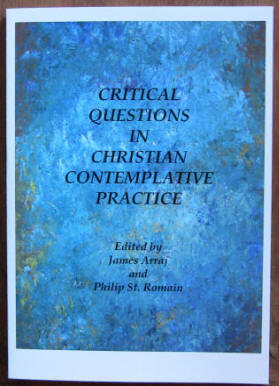 .
. . we face the first sustained practical interest in contemplation
since the end of the 17th century, but already this enthusiasm has
raised critical questions that need to be addressed lest these new
beginnings go astray. Part I introduces us to three modern attempts to
renew the Christian life of prayer. Part II allows us to meet people
today who have had Christian experiences of prayer and contemplation.
Part III explores how the renewal of the Christian contemplative life
is interacting with Eastern forms of meditation. The material here came
originally from shalomplace.com and innerexplorations.com. .
. . we face the first sustained practical interest in contemplation
since the end of the 17th century, but already this enthusiasm has
raised critical questions that need to be addressed lest these new
beginnings go astray. Part I introduces us to three modern attempts to
renew the Christian life of prayer. Part II allows us to meet people
today who have had Christian experiences of prayer and contemplation.
Part III explores how the renewal of the Christian contemplative life
is interacting with Eastern forms of meditation. The material here came
originally from shalomplace.com and innerexplorations.com.Paperback - Kindle - ePub - - - Book (movie, CD) of the Week Praying with Confidence: Aquinas on the Lord's Prayer, by Paul Murray OP. Continuum, 2010. - http://www.amazon.com/dp/1441147136/?tag=christianspiritu (Paperback) - http://www.amazon.com/dp/B005116X22/?tag=christianspiritu (Kindle)  Even though readers
have found Aquinas to be daunting, in this book the author gives
freshness and clarity befitting a great theologian. In other words, the
Lord's Prayer becomes the reader's prayer. Aquinas gives this bit of
wisdom: "Jesus knew exactly what the Father wants to give to God's
children, so Jesus taught this prayer to His apostles that they might
ask for these things from the Father." Even though readers
have found Aquinas to be daunting, in this book the author gives
freshness and clarity befitting a great theologian. In other words, the
Lord's Prayer becomes the reader's prayer. Aquinas gives this bit of
wisdom: "Jesus knew exactly what the Father wants to give to God's
children, so Jesus taught this prayer to His apostles that they might
ask for these things from the Father." In this book Aquinas comes alive not only as teacher, but also as master and guide of the spiritual life. Even though he was known to be a great pray-er, he had to admit that at times his mind wandered far from the act of prayer itself while praying the Lord's Prayer. Aquinas gives his teachings here in a serene manner filled with the wisdom from on high. He believes that this prayer not only teaches us to ask, it also gives shape to our whole affective life. The ten chapters in this book explain in detail each section of the Lord's Prayer, beginning with "Our Father" and ending with "Amen." This book presents one Dominican master interpreting another Dominican master. Murray notes that the Dominican approach to the spiritual life is definitely different than that of a Jesuit or a Carmelite or any other Order. "Dominicans customarily speak of the God who is already present to the one who prays." Hence, two common themes are apparent, namely gift and grace. Murray sees the Dominican way as the path trod by the humble sinner whom God has deigned to address and lift up. Repeating Aquinas, Murray says that in prayer, confidence is of great avail, hence the introduction is OUR FATHER. Among Aquinas' sources used in this book are the Summa Theologiae, his conferences at Naples, his lectures on St. Matthew, and the Compendium of Theology. (Thanks to Sr. Irene Hartman OP for this review.) Make the Christian Spirituality Bookstore your starting point for online shopping at Amazon.com. You can buy books, cds, videotapes, software, appliances and many other products at discount prices. As Amazon.com affiliate, we are paid a small fee for purchases originating from our web site. Every little bit helps! http://shalomplace.com/books/index.html - - - Saint of the Week - http://www.americancatholic.org/features/saints/saint.aspx?id=1178 - St. Anthony Claret (1807-1870): October 24  The "spiritual father of Cuba"
was a missionary, religious founder, social reformer, queen's chaplain,
writer and publisher, archbishop and refugee. He was a Spaniard whose
work took him to the Canary Islands, Cuba, Madrid, Paris and to the
First Vatican Council. The "spiritual father of Cuba"
was a missionary, religious founder, social reformer, queen's chaplain,
writer and publisher, archbishop and refugee. He was a Spaniard whose
work took him to the Canary Islands, Cuba, Madrid, Paris and to the
First Vatican Council.In his spare time as weaver and designer in the textile mills of Barcelona, he learned Latin and printing: The future priest and publisher was preparing. Ordained at 28, he was prevented by ill health from entering religious life as a Carthusian or as a Jesuit, but went on to become one of Spain's most popular preachers. He spent 10 years giving popular missions and retreats, always placing great emphasis on the Eucharist and devotion to the Immaculate Heart of Mary. Her rosary, it was said, was never out of his hand. At 42, beginning with five young priests, he founded a religious institute of missionaries, known today as the Claretians. He was appointed to head the much-neglected archdiocese of Santiago in Cuba. He began its reform by almost ceaseless preaching and hearing of confessions, and suffered bitter opposition mainly for stamping out concubinage and giving instruction to black slaves. A hired assassin (whose release from prison Anthony had obtained) slashed open his face and wrist. Anthony succeeded in getting the would-be assassin's death sentence commuted to a prison term. His solution for the misery of Cubans was family-owned farms producing a variety of foods for the family's own needs and for the market. This invited the enmity of the vested interests who wanted everyone to work on a single cash crop--sugar. Besides all his religious writings are two books he wrote in Cuba: Reflections on Agriculture and Country Delights. He was recalled to Spain for a job he did not relish--being chaplain for the queen. He went on three conditions: He would reside away from the palace, he would come only to hear the queen's confession and instruct the children and he would be exempt from court functions. In the revolution of 1868, he fled with the queen's party to Paris, where he preached to the Spanish colony. All his life Anthony was interested in the Catholic press. He founded the Religious Publishing House, a major Catholic publishing venture in Spain, and wrote or published 200 books and pamphlets. At Vatican I, where he was a staunch defender of the doctrine of infallibility, he won the admiration of his fellow bishops. Cardinal Gibbons of Baltimore remarked of him, "There goes a true saint." At the age of 63, he died in exile near the border of Spain. - - - Web
Resource of the Week
Obama and Romney on the Issues (mostly relevant to U.S. citizens) If you're like me, you've probably found that the TV ads are more noise than light. The debates have been a little better, though so contentious at times and with so many rebutalls as to leave one wondering just what either candidate plans to do. Fortunately, there are a number of web sites that provide concise summaries of their positions on a number of issues. What follows are a few links worthy of visiting. From the Wall St. Journal: a slideshow (click links in left sidebar) From iSideWith.com: short summary Yahoo News: more detailed contrast Entertainment: Mitt Romney and I dance to "Hail to the Chief." (You won't learn much from that link.) |


|