|
Message of the Day
|
|
Can you see the holiness in those things you take for granted - a paved road or a washing machine? If you concentrate on finding what is good in every situation, you will discover that your life will suddenly be filled with gratitude, a feeling that nurtures the soul.
- Rabbi Harold Kushner
|
|
Readings of the Day
|
Zechariah
8:20-23
Psalm 87:1b-3, 4-5, 6-7 Luke 9:51-56 As the time drew near for him to be taken up to heaven, Jesus resolutely took the road for Jerusalem and sent messengers ahead of him. These set out, and they went into a Samaritan village to make preparations for him, but the people would not receive him because he was making for Jerusalem.
Seeing this, the disciples James and John said, ‘Lord, do you want us to call down fire from heaven to burn them up?’ But he turned and rebuked them, and they went off to another
village. USCCB lectionary
|
|
Reflection on the Scripture
|
Jesus “set His face to go to Jerusalem.” —Luke 9:51, RSV-CE
Jesus “firmly resolved to proceed toward Jerusalem” (Lk 9:51). This was one of the most
important decisions in human history. This decision to go to Jerusalem was a crucial moment in God’s plan of salvation, for it ended in Jesus’ saving death and glorious Resurrection.
Immediately after making this decision, Jesus was opposed by Samaritans and had to rebuke Sts. James and John to deliver them from the evil one (Lk 9:53, 55). We likewise face serious problems after we make our most important decisions for Jesus. How many
people have been rejected by their friends and co-workers after they have decided to give their lives to Jesus? So many Christians have made the decision to be pure, only to face what seemed to be huge temptations, and even abuse, for trying to live a holy life. After I had “set my face” toward the vocation of the priesthood, the devil tried to talk me out of it by spotlighting many abuses in the Church. Many Christian couples, after they
have “set their faces” toward becoming a holy family, experience financial difficulties. Those who set their faces in obedience to God have unsettling experiences. Nevertheless, we all must keep our faces set towards God’s will in our life. If we do, we will finally rise from the dead after having suffered and died for love of Jesus. Set your face (see Is 50:7). Prayer: Father,
may I not move to the right or to the left, but be set in Your ways (Dt 5:32; Prv 4:25-27). Promise: “Many peoples and strong nations shall come to seek the Lord of hosts in Jerusalem and to implore the favor of the Lord.” —Zec 8:22 Praise: St. Jerome (feast day) spent four years in the desert, learning God’s Word in solitude and
prayer. Presentation Ministries
|
|
Spiritual Reading
|
|
|
|
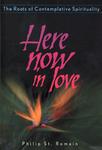
Here Now in Love: The Roots of Contemplative Spirituality, by Philip St. Romain. Liguori Publications, 2001.
https://amzn.to/4n3bu4j The Four Modes of Christ's Presence to
Us Third: Sacramental A traditional understanding of the term sacrament is that it is a sign instituted by Christ to give grace. In many
ways, then, the Church is the first sacrament of Christ, as it is a visible sign of his presence and a means through which his grace is given. The Church is also the living context in which other sacramental experiences take place--some of which are formally designated to call to mind Christ’s presence in special ways. All Christian denominations recognize baptism as a sign of initiation into new life in Christ and membership in the Church (they don’t all use the term sacrament,
however). Many others also celebrate Eucharist, although there are differences among the Churches concerning the nature of Christ’s presence there. In addition, Churches close to the Catholic tradition recognize matrimony, confirmation, penance, holy orders, and anointing of the sick as sacramental experiences. One of the primary purposes of sacraments is to help us realize that Christ is with us during those special
times and rites of passage in life. His self-communication through a sacramental mode speaks to our ordinary, human modes of knowing, but invokes symbols which point beyond the literal unto transcendence. For example, we understand that water is commonly used to quench our thirst and as a cleansing agent. When it is used in baptism, we intuitively understand that just as water cleanses a body, so, too, does Christ cleanse the soul, and that he is the Living Water who will now
quench our deepest thirst. The water used is ordinary, but it points to the Living Water, which is the extraordinary. Likewise, bread and wine broken and shared in Eucharist maintain their appearance, but communicate now the Body and Blood of Christ. A married couple show love to one another, and this signifies the love between Christ and the Church. And so forth. In terms of the spiritual life, we can say that
sacraments help to train us to look beyond the literal toward a deeper reality. They do not reject the literal or ordinary modes of human knowing; the forms used in sacraments are not merely incidental, but essential. But they do lead us to be open to modes of encountering Christ beyond what the senses and the concepts of the mind are familiar with. They are like windows into the spiritual realm: we can look through them and find Christ looking back, and if we open the windows
by receiving the sacraments in faith, we can be refreshed by the breath of his Spirit. |
Please support this outreach with a tax-deductible donation. |
|
|